GSK — Rate my Trial
Category
Product Design, Strategy, WebAbout This Project
The Setup
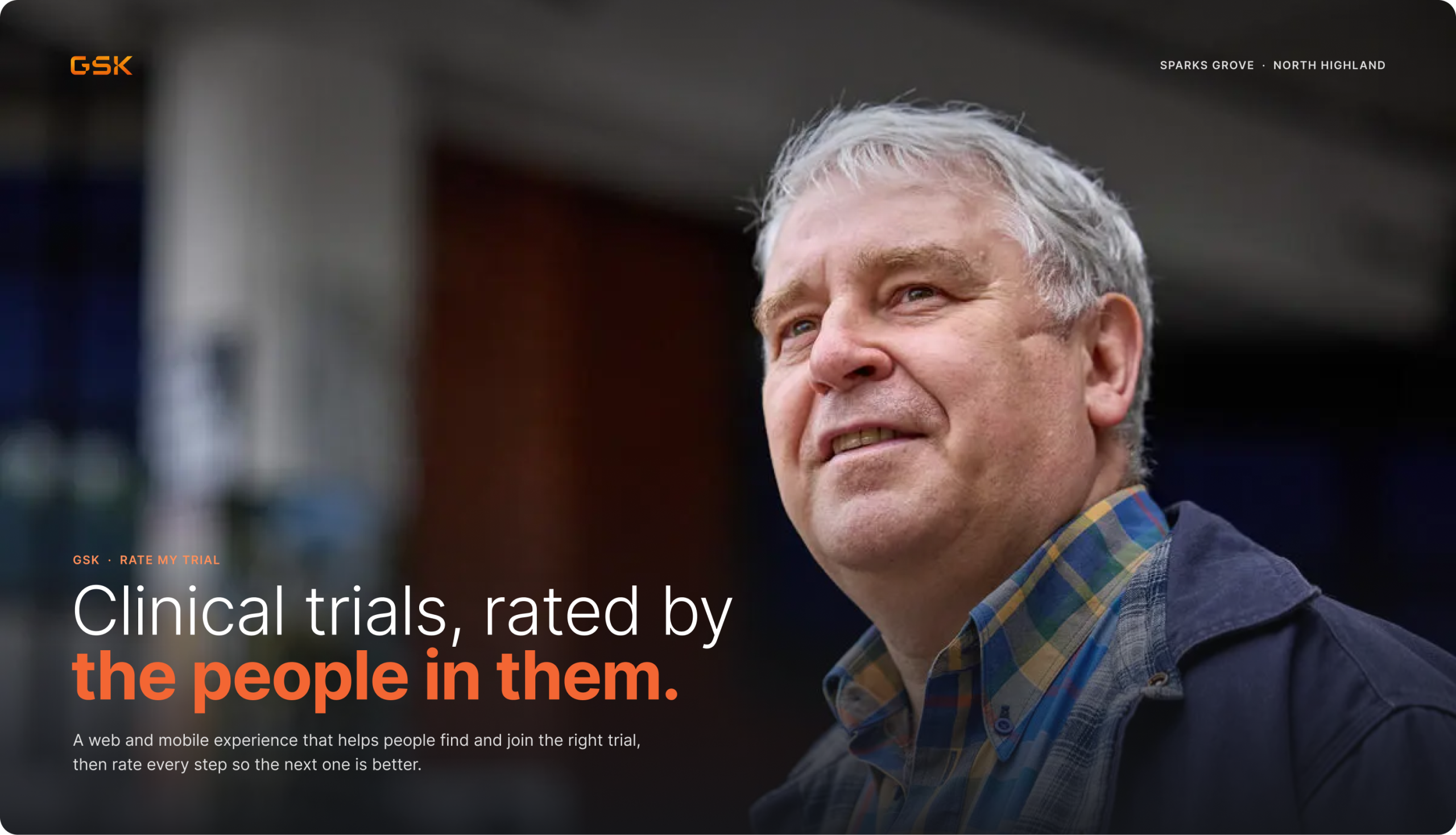
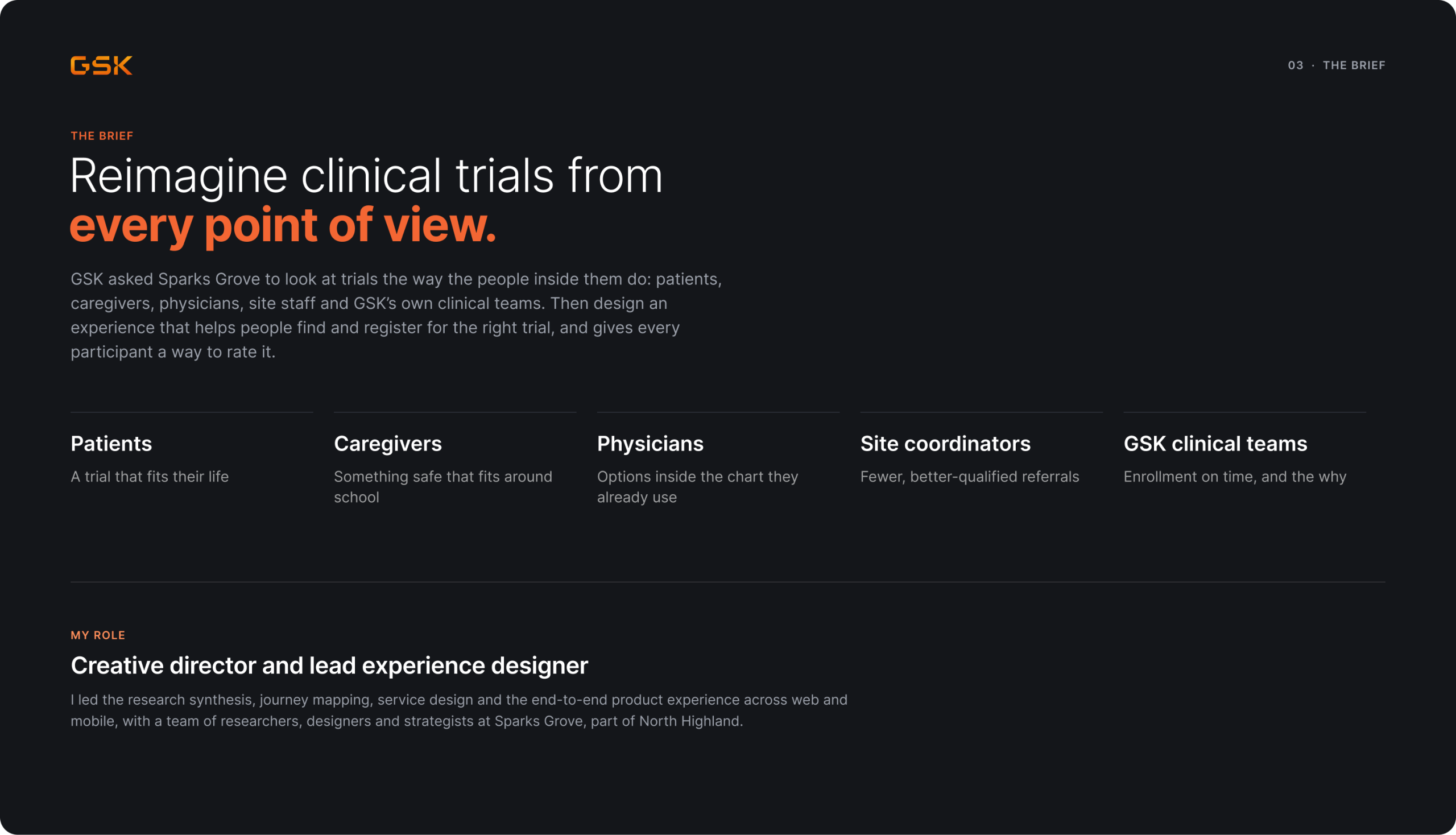
Rate my Trial is a web and mobile experience that helps people find and join the clinical trial that fits their life, then lets them rate every step so GSK can make the next trial better. GSK (formerly GlaxoSmithKline) brought us in to reimagine clinical trials from the point of view of everyone involved: patients, caregivers, physicians, site staff and GSK’s own clinical teams.
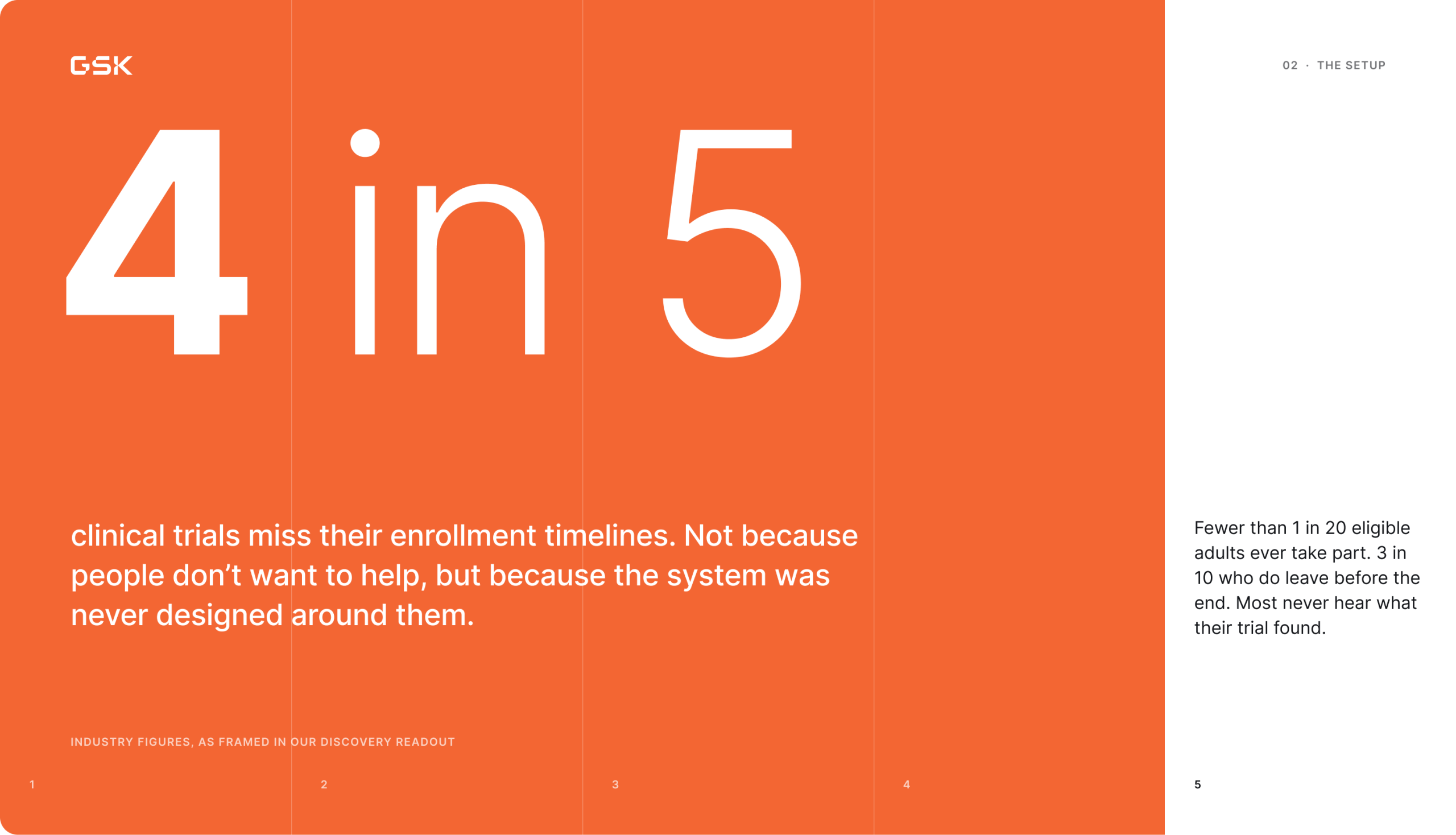
Four in five clinical trials miss their enrollment timelines. It isn’t because people don’t want to help; it’s because the system was never designed around them. Fewer than 1 in 20 eligible adults ever take part, 3 in 10 who do join leave before the end, and most never hear what their trial found.
GSK’s brief was broad on purpose. They asked us to look at trials the way the people inside them experience them, then design an experience that helps people find and register for the right trial and gives every participant a way to rate it. That feedback had to flow back to the study teams and to GSK so the experience could keep improving while a trial was still running.
What I Led
I was the creative director and lead experience designer on the engagement. I led the research synthesis, journey mapping, service design and the end-to-end product experience across desktop and mobile, working with a team of researchers, designers and strategists, and alongside GSK’s clinical operations, medical writing and digital teams.
Human-centered design sat at the center of how we worked. Every decision traced back to something we heard from a patient, a caregiver, a physician or a site coordinator, and we put prototypes in front of those same people before anything moved forward.
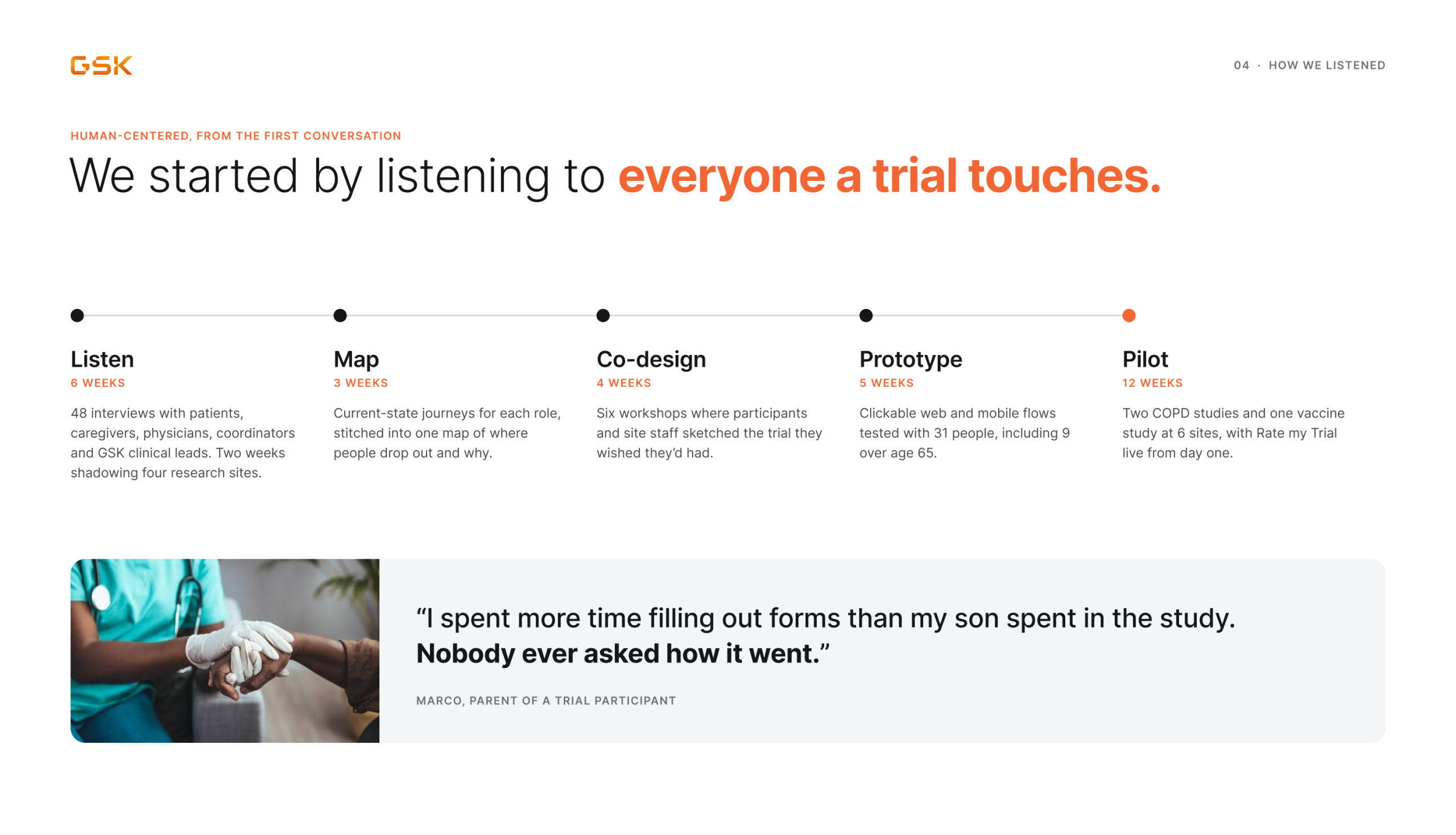
We started by listening to everyone a trial touches. Over five phases we moved from listening to a live pilot:
- Listen. 48 interviews with patients, caregivers, physicians and site staff, plus shadowing days at four research sites.
- Map. Current-state journeys for each group, laid on top of each other to show where the handoffs broke.
- Co-design. Working sessions where participants and coordinators sketched the experience they wished they’d had.
- Prototype. Clickable desktop and mobile flows tested with 31 people, many of them former trial participants.
- Pilot. Two COPD studies and one vaccine study, across six sites, for 12 weeks.
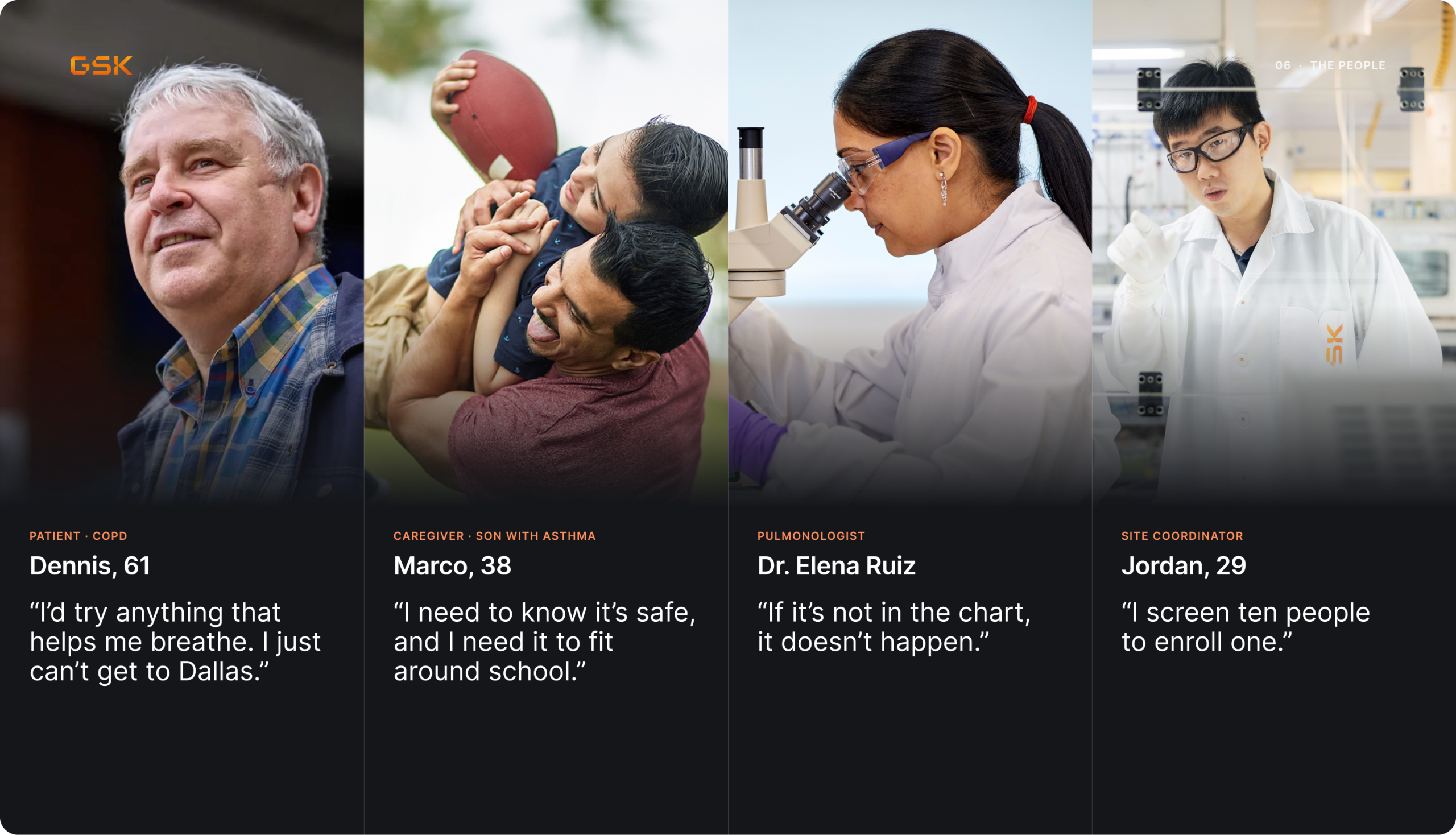
Four people anchored the work:
- Dennis, 61 — a patient with COPD: “I’d try anything that helps me breathe. I just can’t get to Dallas.”
- Marco, 38 — dad of a son with asthma: “I need to know it’s safe, and I need it to fit around school.”
- Dr. Elena Ruiz — a pulmonologist: “If it’s not in the chart, it doesn’t happen.”
- Jordan, 29 — a site coordinator: “I screen ten people to enroll one.”
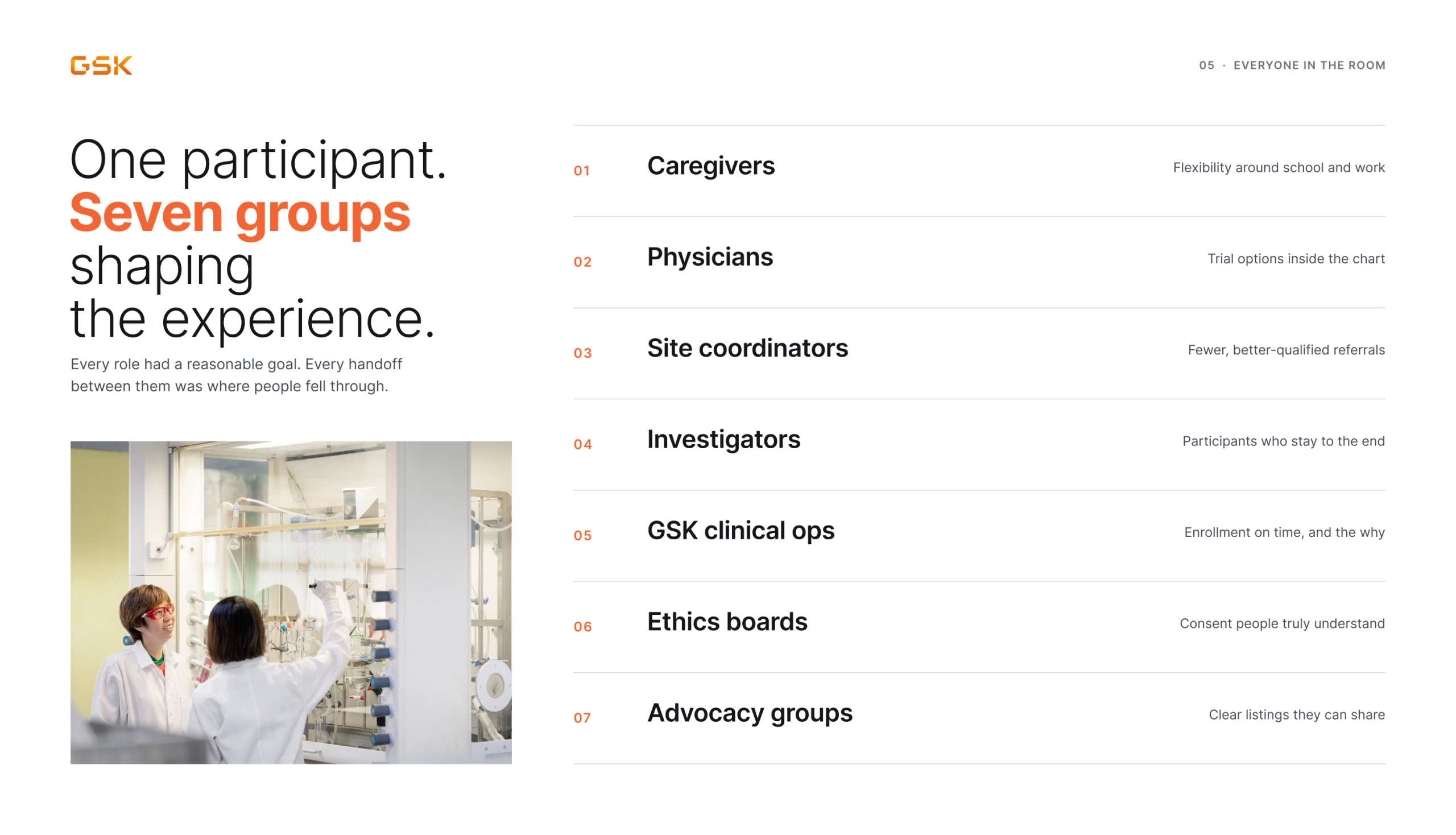
The research also made the ecosystem visible. Seven groups shape a single participant’s experience, from caregivers and physicians to ethics boards and advocacy groups, and each had a reasonable goal. The friction lived in the handoffs between them.
The Idea: A Trial That Listens Back
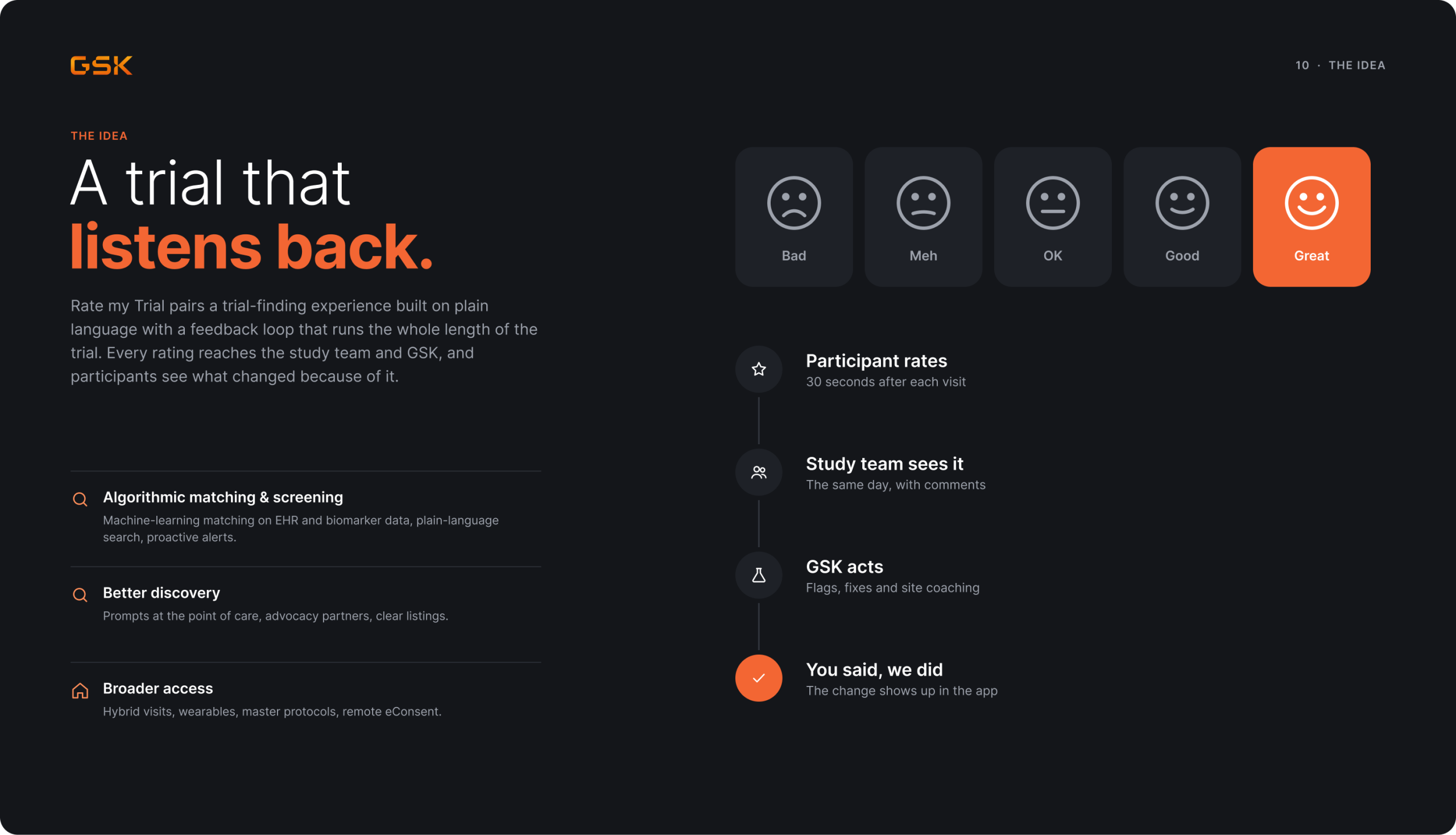
Rate my Trial pairs a trial-finding experience built on plain language with a feedback loop that runs the whole length of the trial. After every touchpoint a participant can rate how it went in about 30 seconds. The study team sees it the same day, GSK acts on patterns across sites, and participants see what changed because of what they said.
Three pillars held the concept together:
- Algorithmic matching and screening. Machine-learning models match people to trials using EHR and biomarker data, a plain-language search replaces registry filters, and opt-in alerts tell people when a trial opens near them.
- Better discovery. Trial prompts at the point of care, inside the record physicians already use, plus outreach through advocacy groups and clearer trial summaries written for patients.
- Broader access. Hybrid and decentralized visits, wearables, master protocols that offer more than one study arm, and remote eConsent.
The Experience
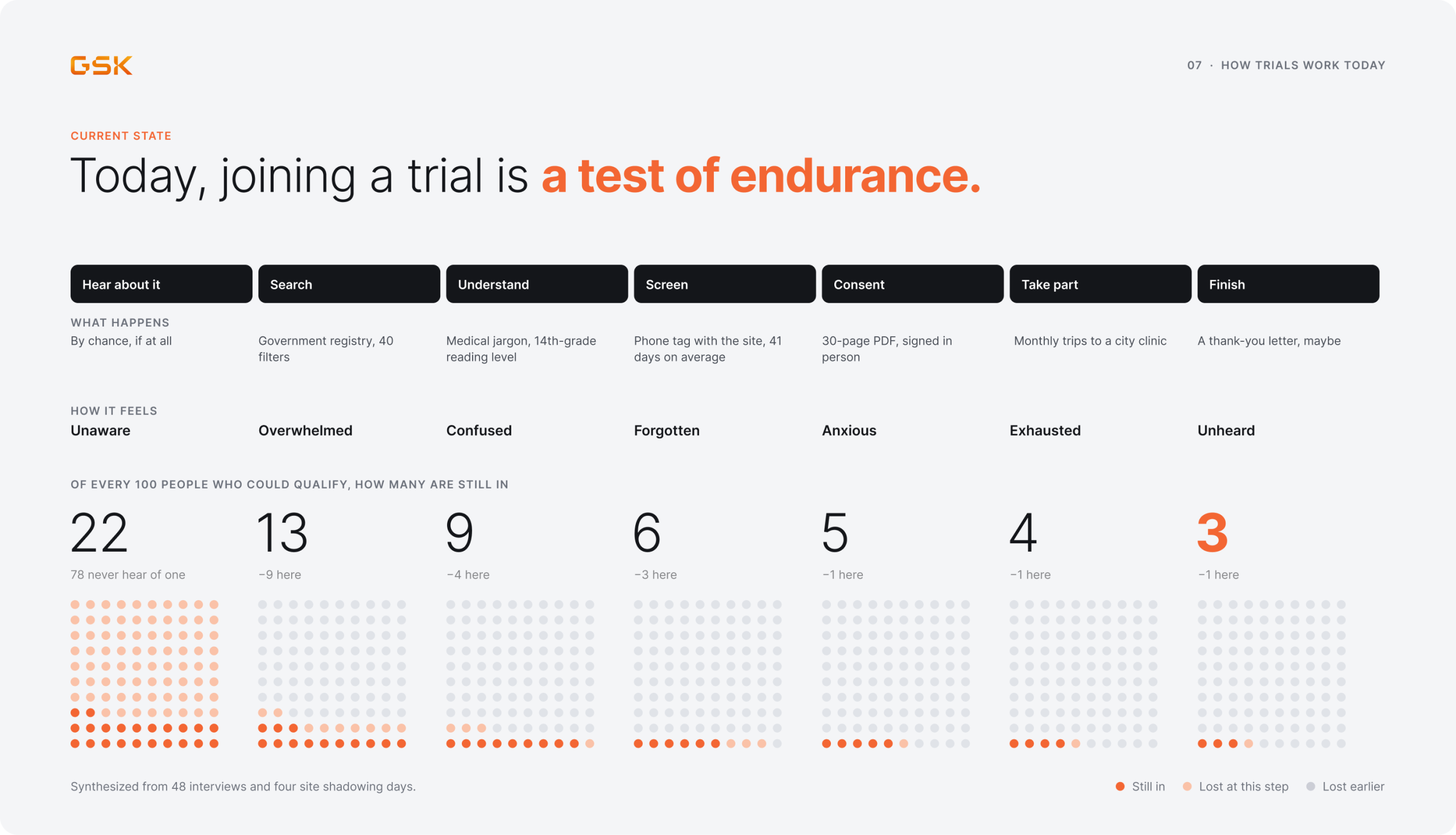
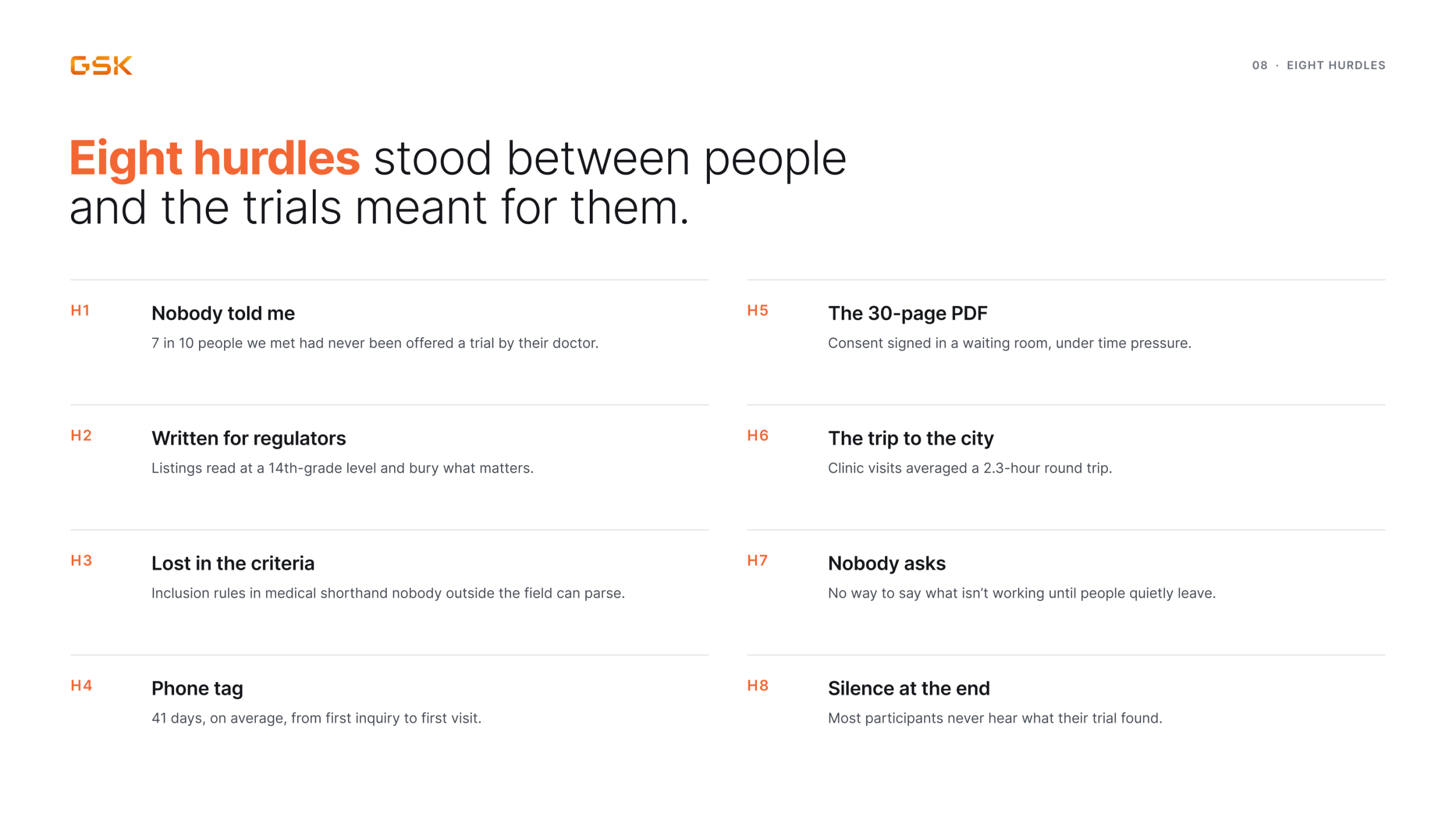
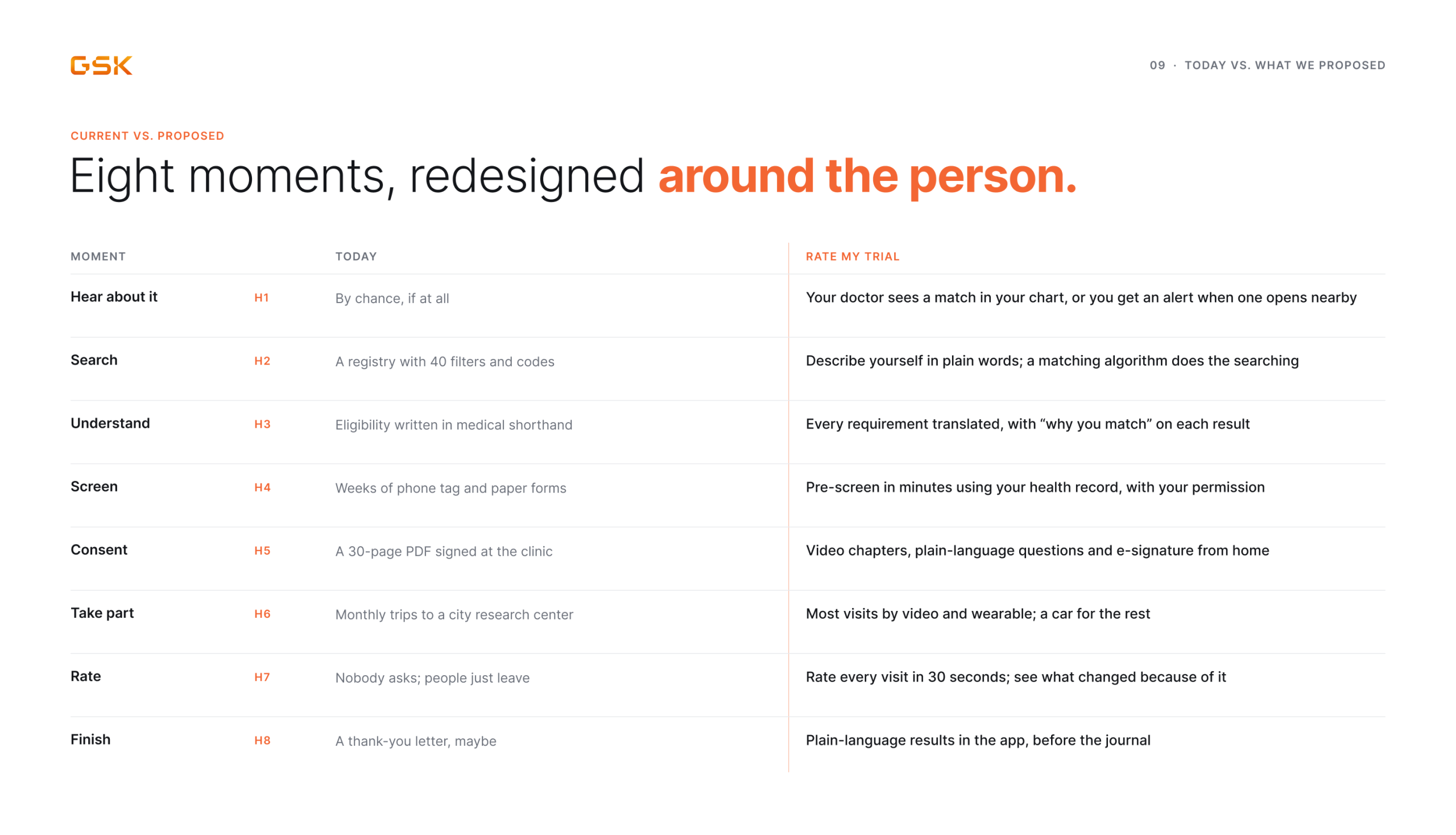
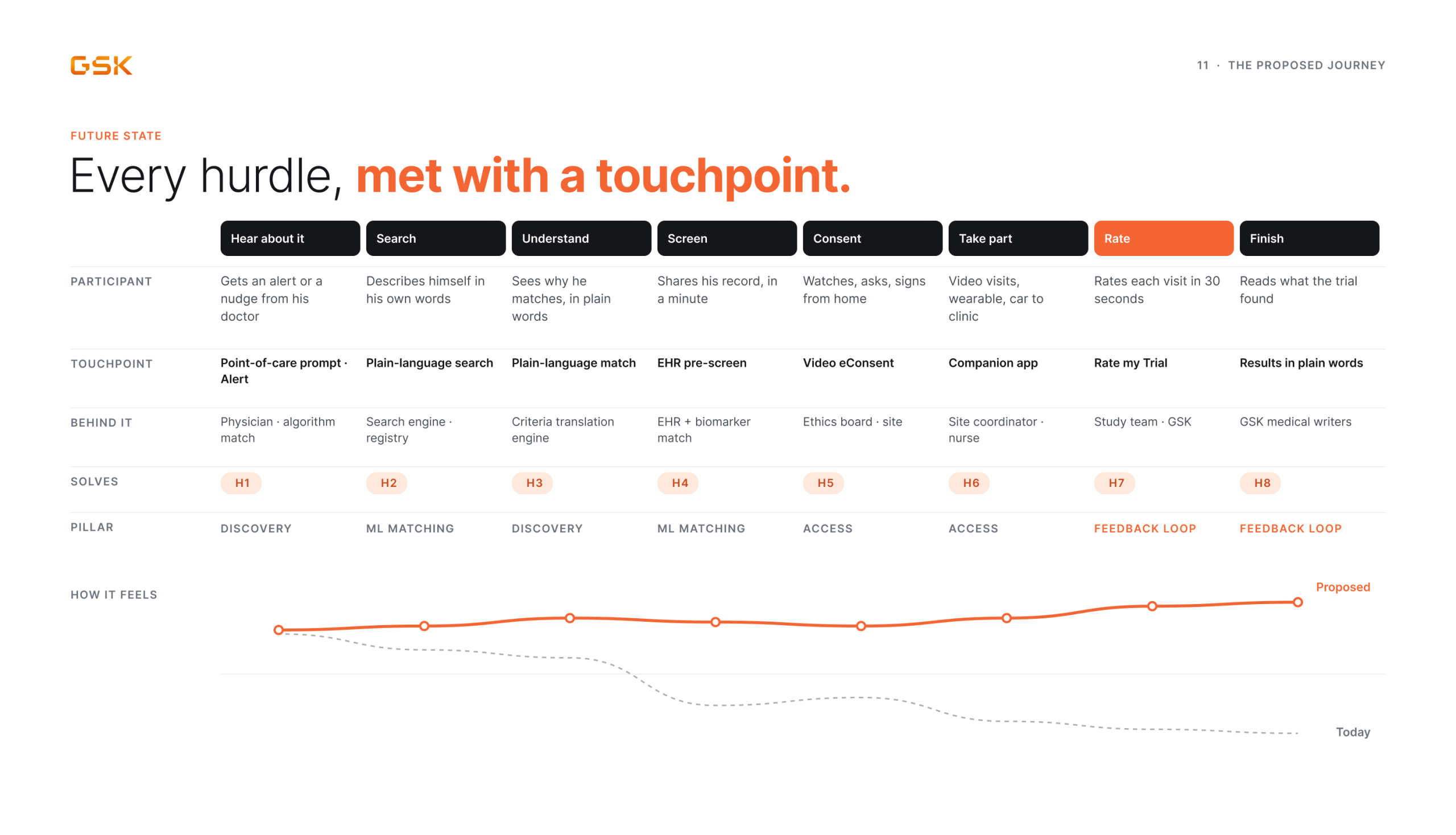
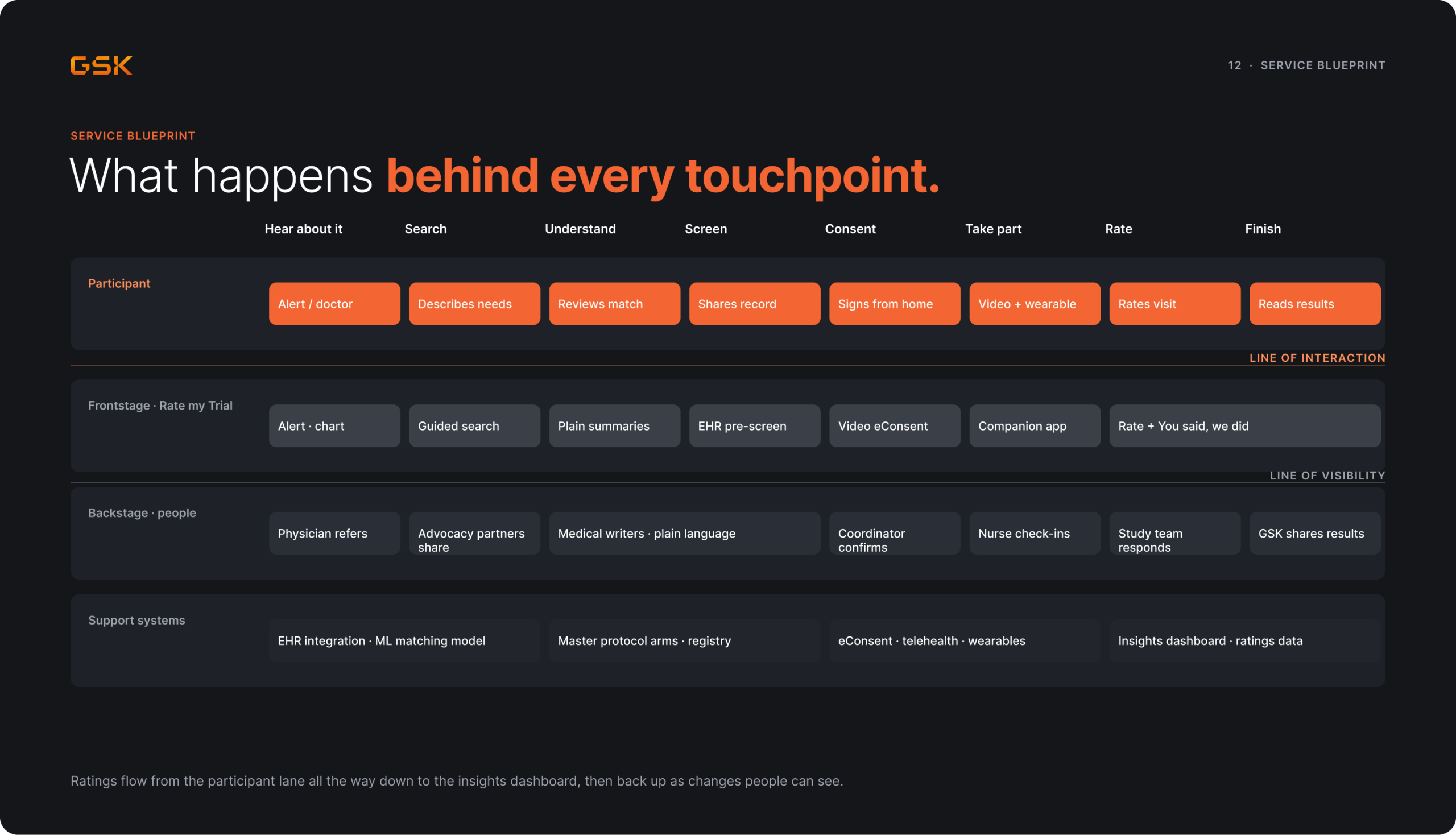
Today, joining a trial is a test of endurance. We mapped eight moments, from hearing about a trial to finishing one, and followed what happens to 100 people who could qualify: only 22 ever hear about a trial, and by the end just 3 are still in. The feelings along the way told the same story — unaware, overwhelmed, confused, forgotten, anxious, exhausted and, at the end, unheard. We named eight hurdles standing between people and the trials meant for them, kept the same eight moments, and redesigned each one around the person, so every hurdle is met by a specific touchpoint. A service blueprint mapped what happens behind each one, from the physician and the site coordinator to the medical writers, the matching model and the ratings dashboard.
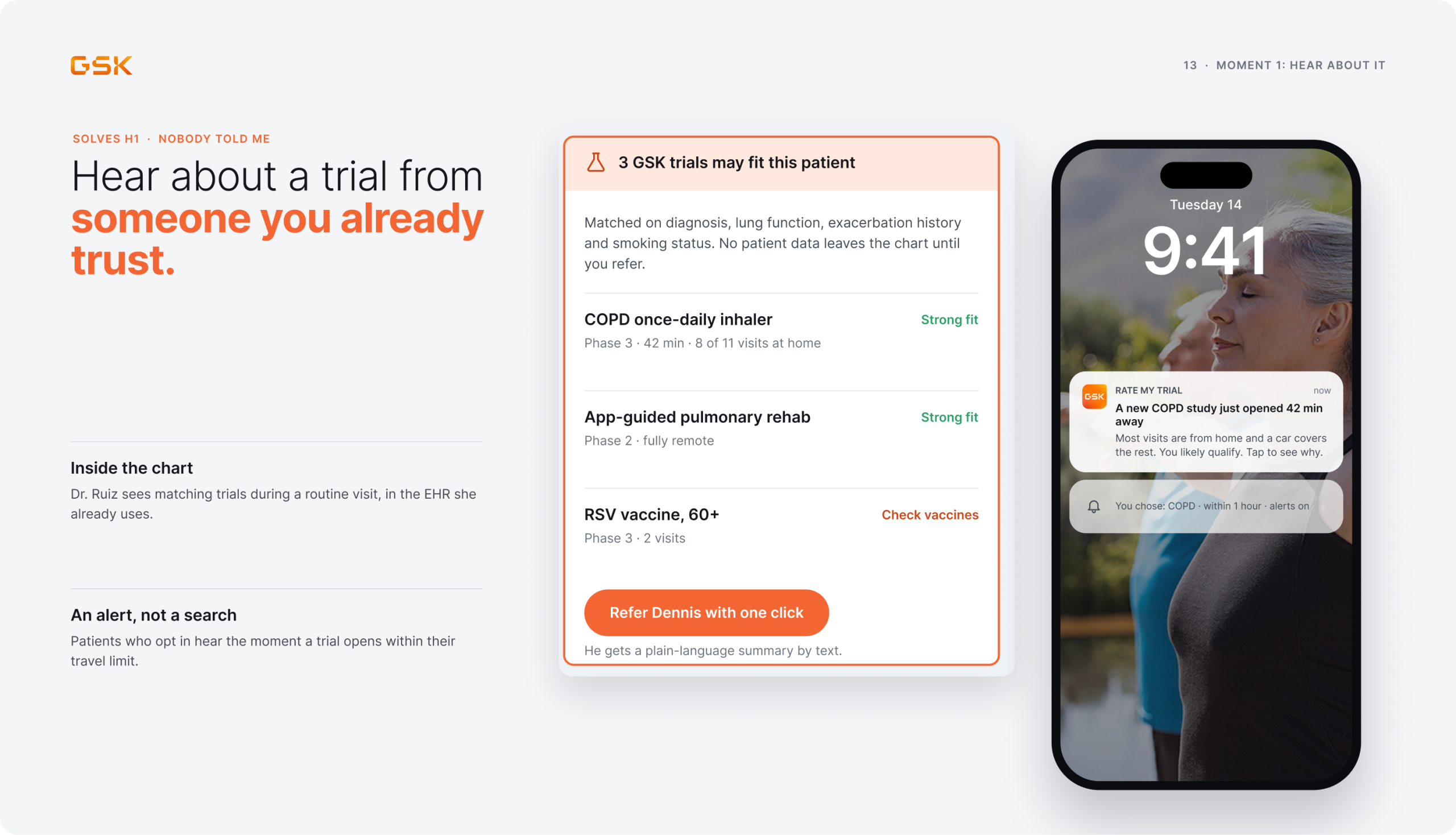
- Hear about it. Today it happens by chance, if at all — 7 in 10 people we met had never been offered a trial by their doctor. With Rate my Trial, the doctor sees a match in the chart, or an alert arrives when a trial opens nearby. (Solves H1: Nobody told me.)
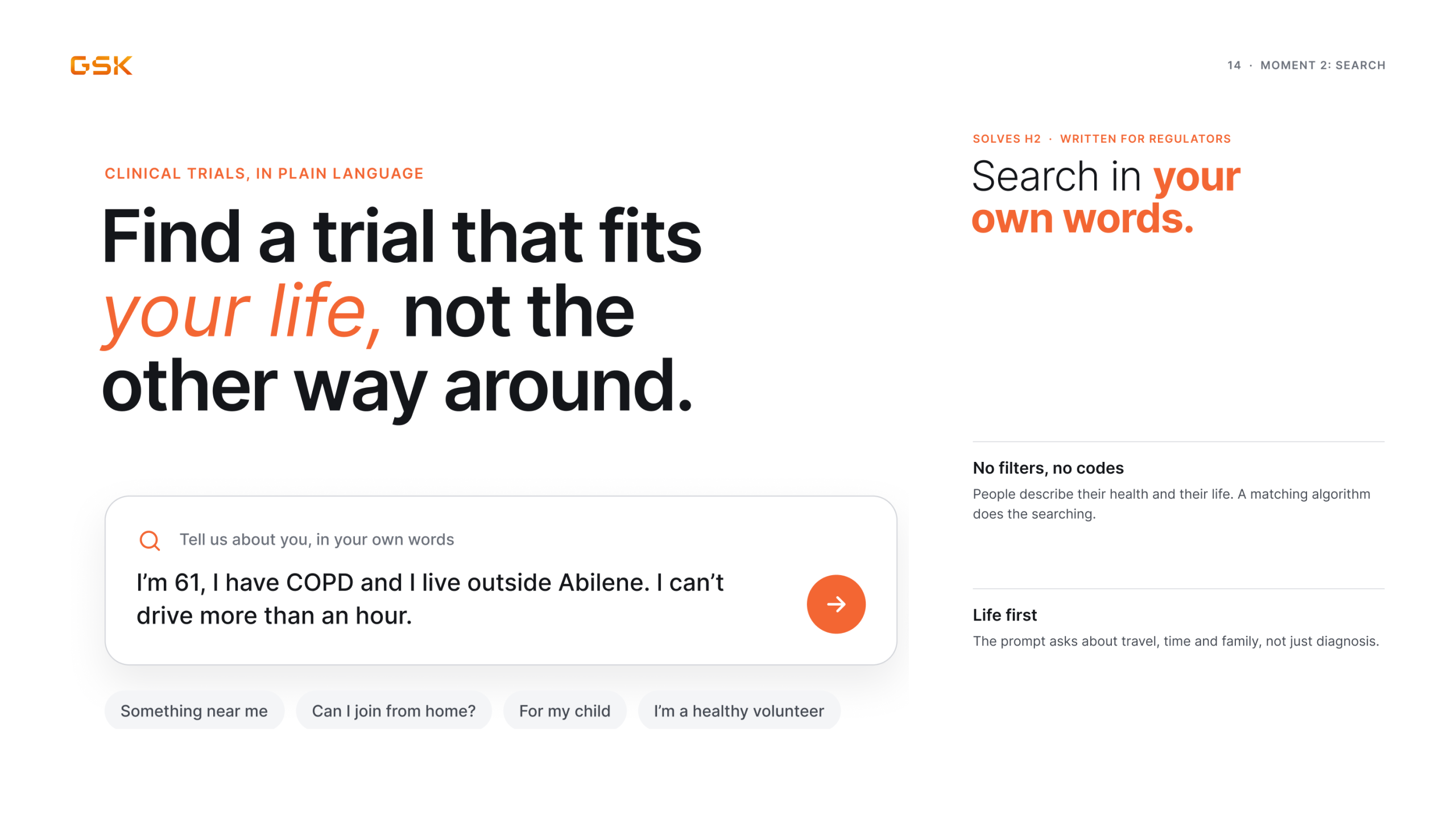
- Search. Today it’s a registry with 40 filters and codes, written at a 14th-grade level. Instead, you describe yourself in plain words and a matching algorithm does the searching. (Solves H2: Written for regulators.)
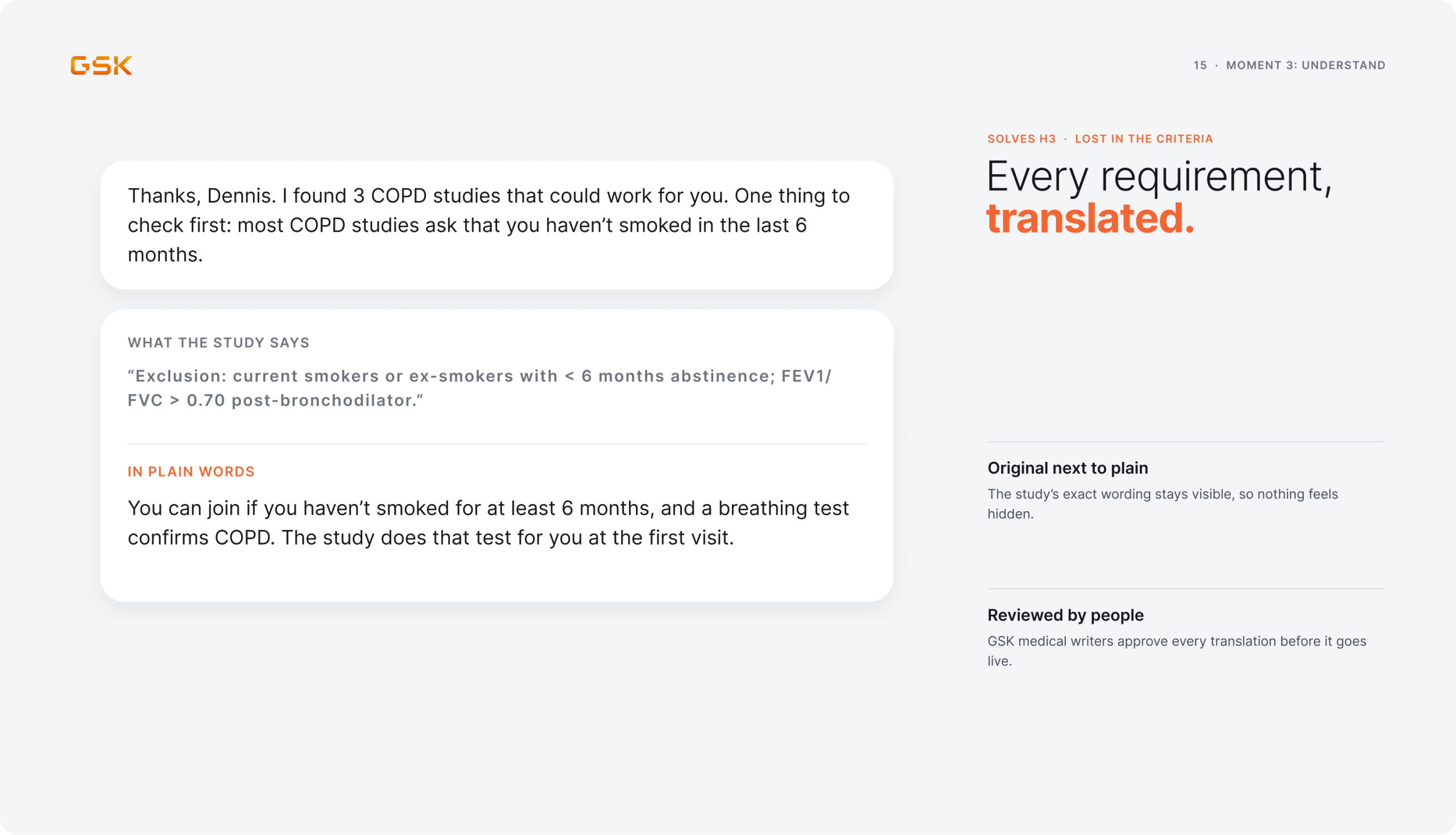
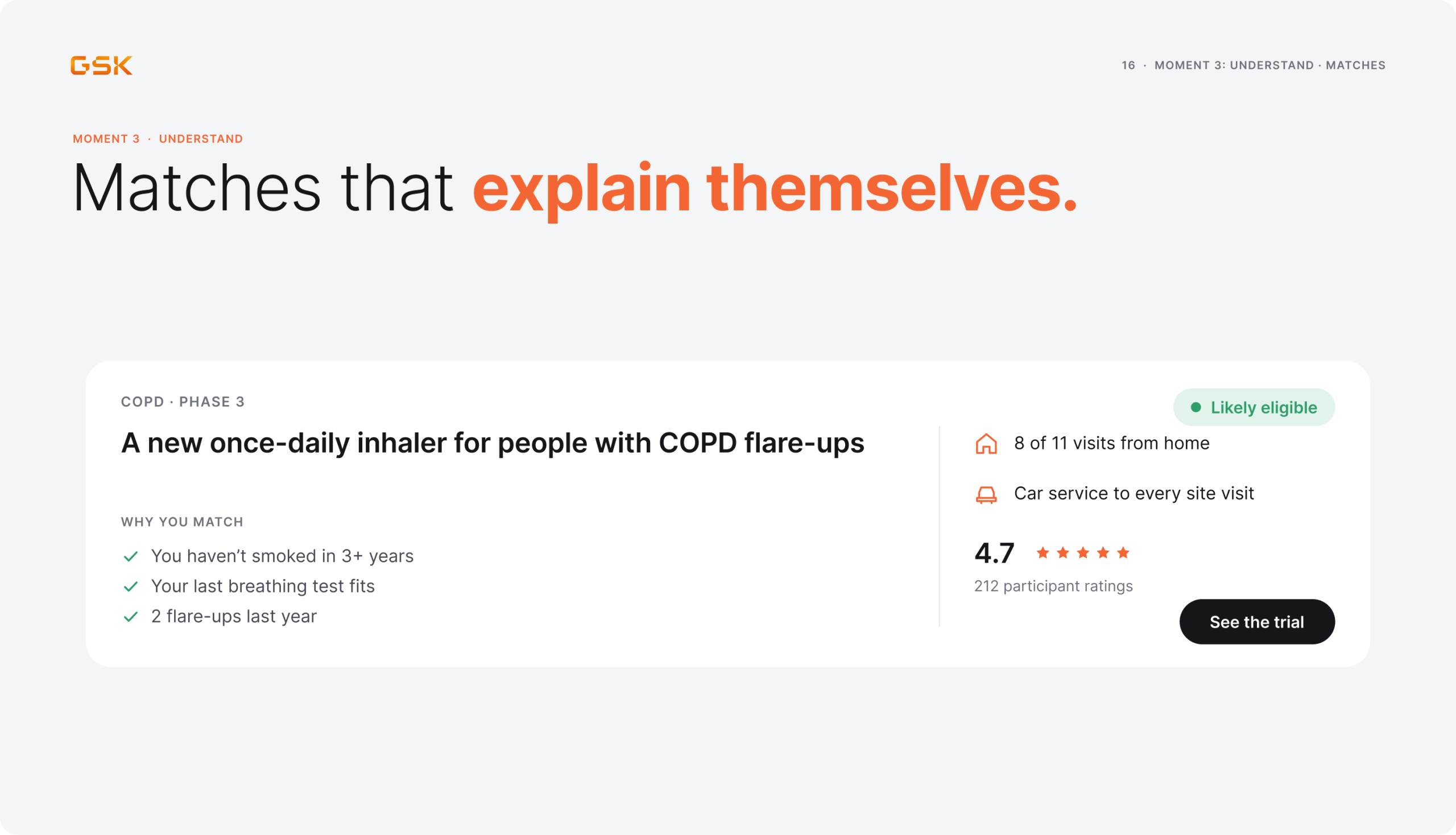
- Understand. Eligibility written in medical shorthand becomes every requirement translated, with “why you match” on each result. (Solves H3: Lost in the criteria.)
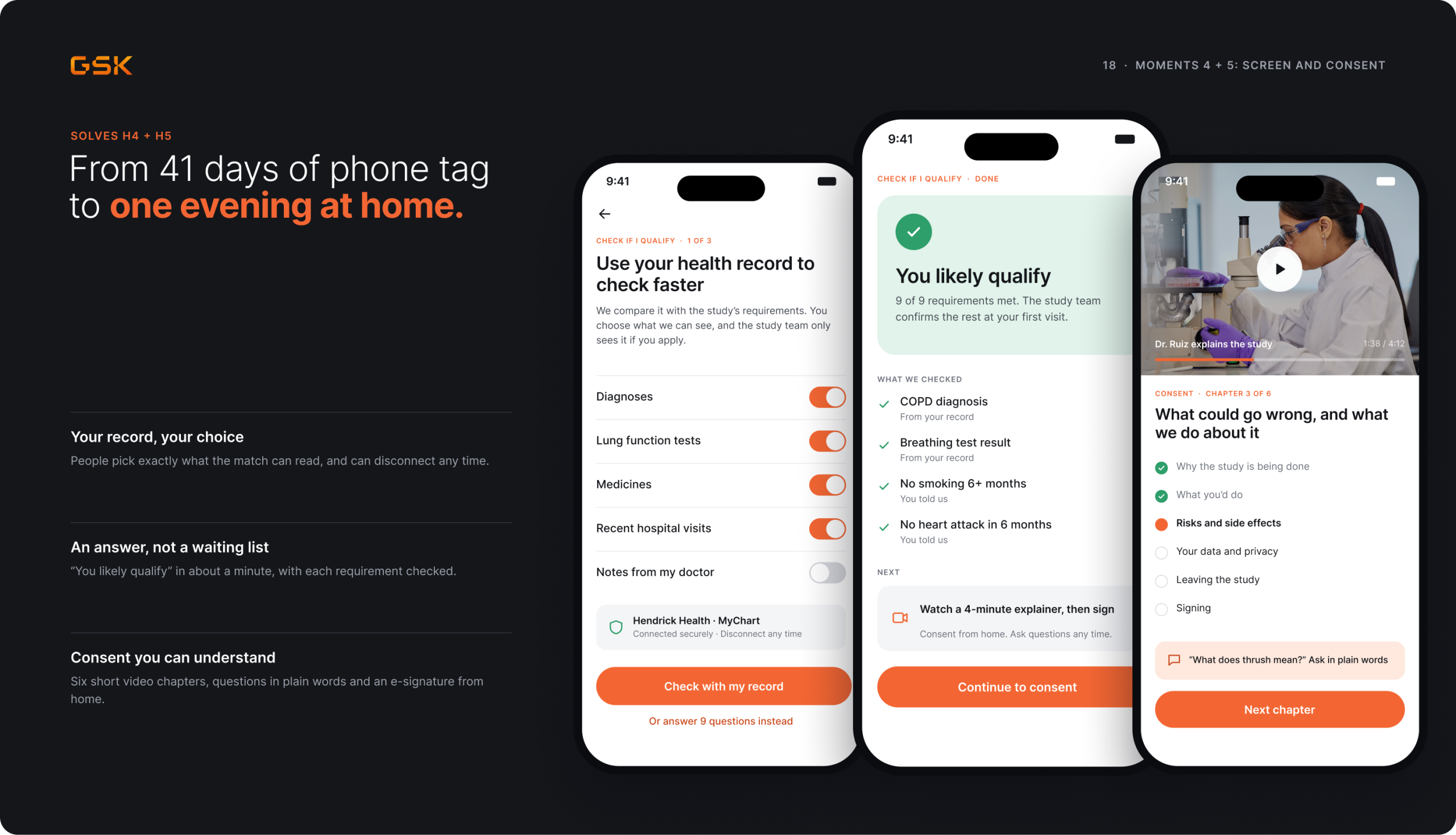
- Screen. Weeks of phone tag and paper forms — 41 days on average from first inquiry to first visit — become a pre-screen in minutes using your health record, with your permission. (Solves H4: Phone tag.)
- Consent. A 30-page PDF signed in a waiting room, under time pressure, becomes video chapters, plain-language questions and e-signature from home. (Solves H5: The 30-page PDF.)
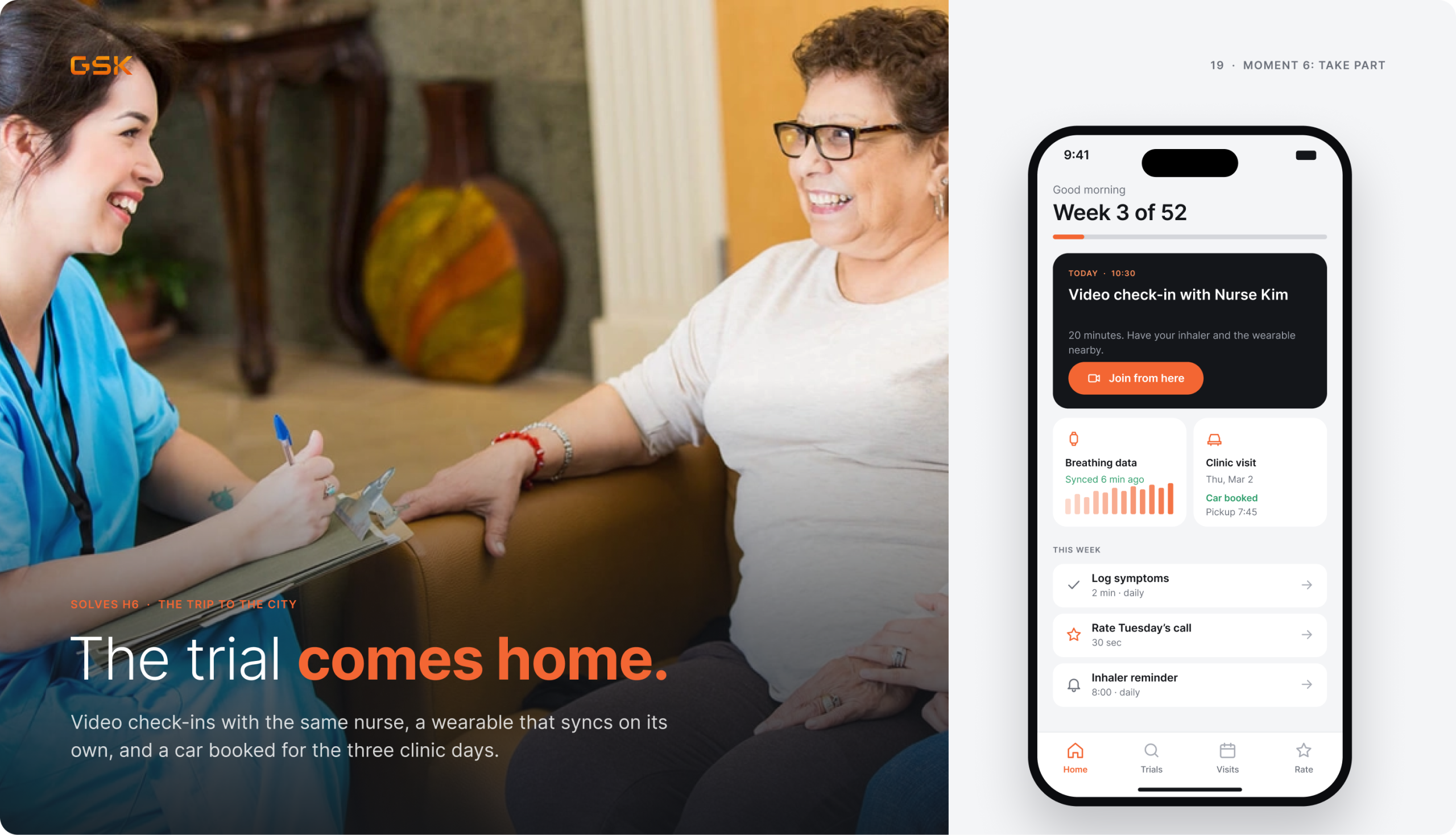
- Take part. Monthly trips to a city research center — a 2.3-hour round trip on average — become most visits by video and wearable, with a car booked for the rest. (Solves H6: The trip to the city.)
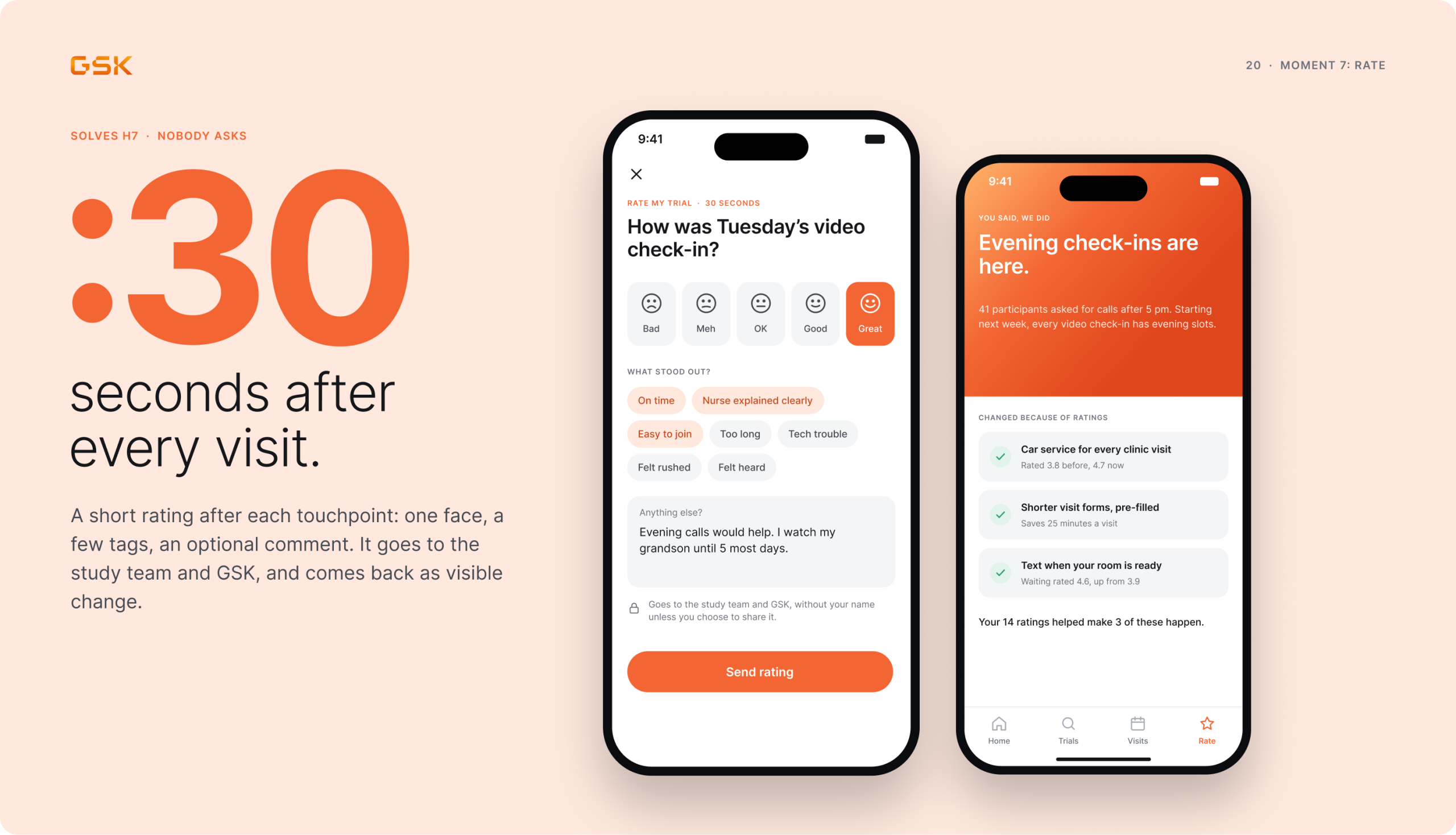
- Rate. Today nobody asks, and people just leave. With Rate my Trial, you rate every visit in 30 seconds and see what changed because of it. (Solves H7: Nobody asks.)
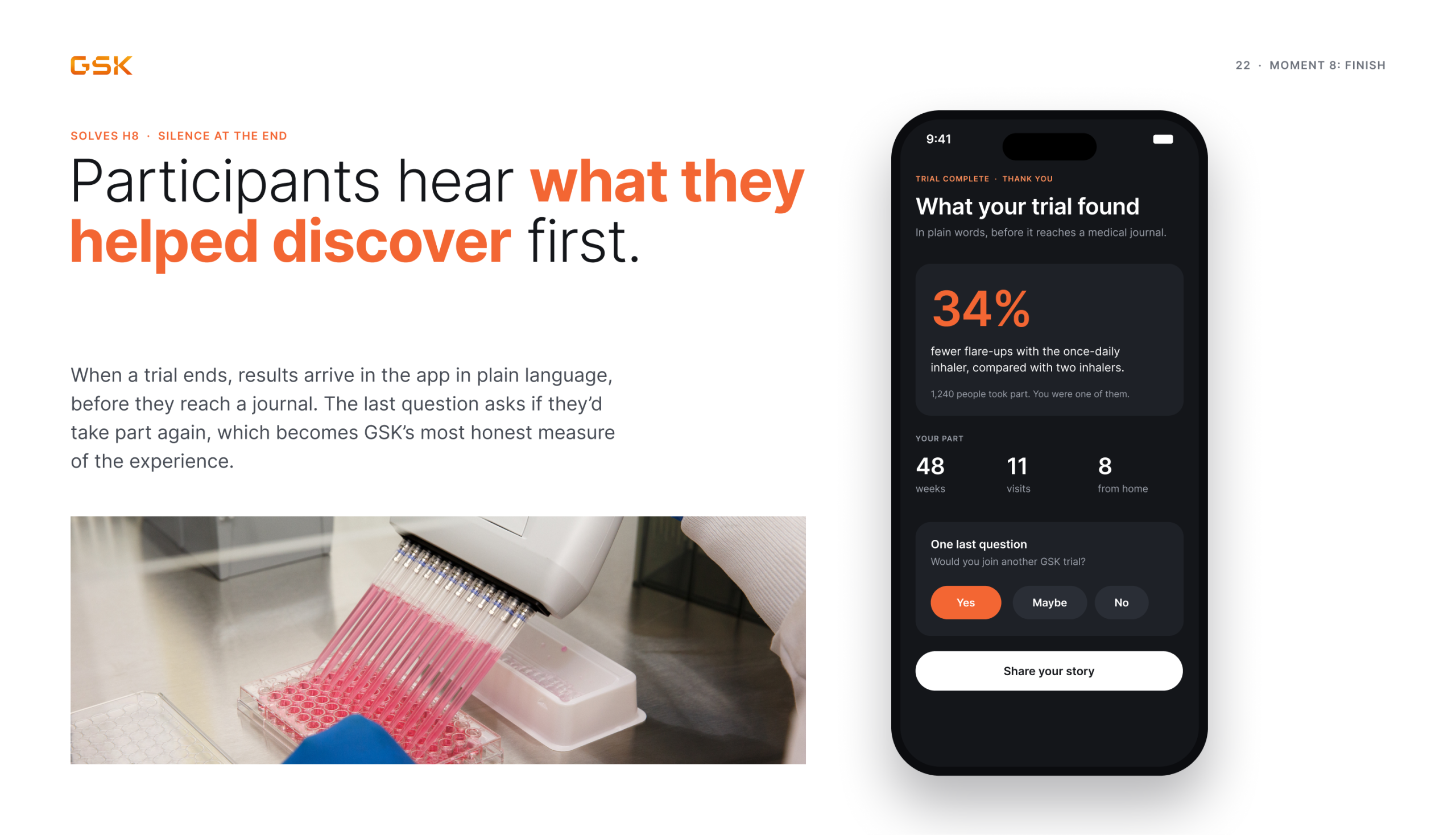
- Finish. Instead of a thank-you letter, maybe, results arrive in the app in plain language, before the journal. (Solves H8: Silence at the end.)
We designed Rate my Trial as a responsive web experience for finding and joining a trial and a companion mobile app for taking part. Here’s how it plays out for Dennis:
- 1. Hear about it. During a routine visit, Dr. Ruiz sees three matching GSK trials in the EHR she already uses and refers Dennis in one click. He gets a plain-language summary by text, and people who opt in get an alert the moment a trial opens within their travel limit.
- 2. Search. Instead of filters and codes, Dennis types “I’m 61, I have COPD and I live outside Abilene. I can’t drive more than an hour.” The prompt asks about travel, time and family, not just diagnosis.
- 3. Understand. Every requirement sits next to a plain-language translation reviewed by GSK medical writers. Each match explains itself: which criteria he meets, where visits happen and what’s covered, plus real ratings from people already in the trial.
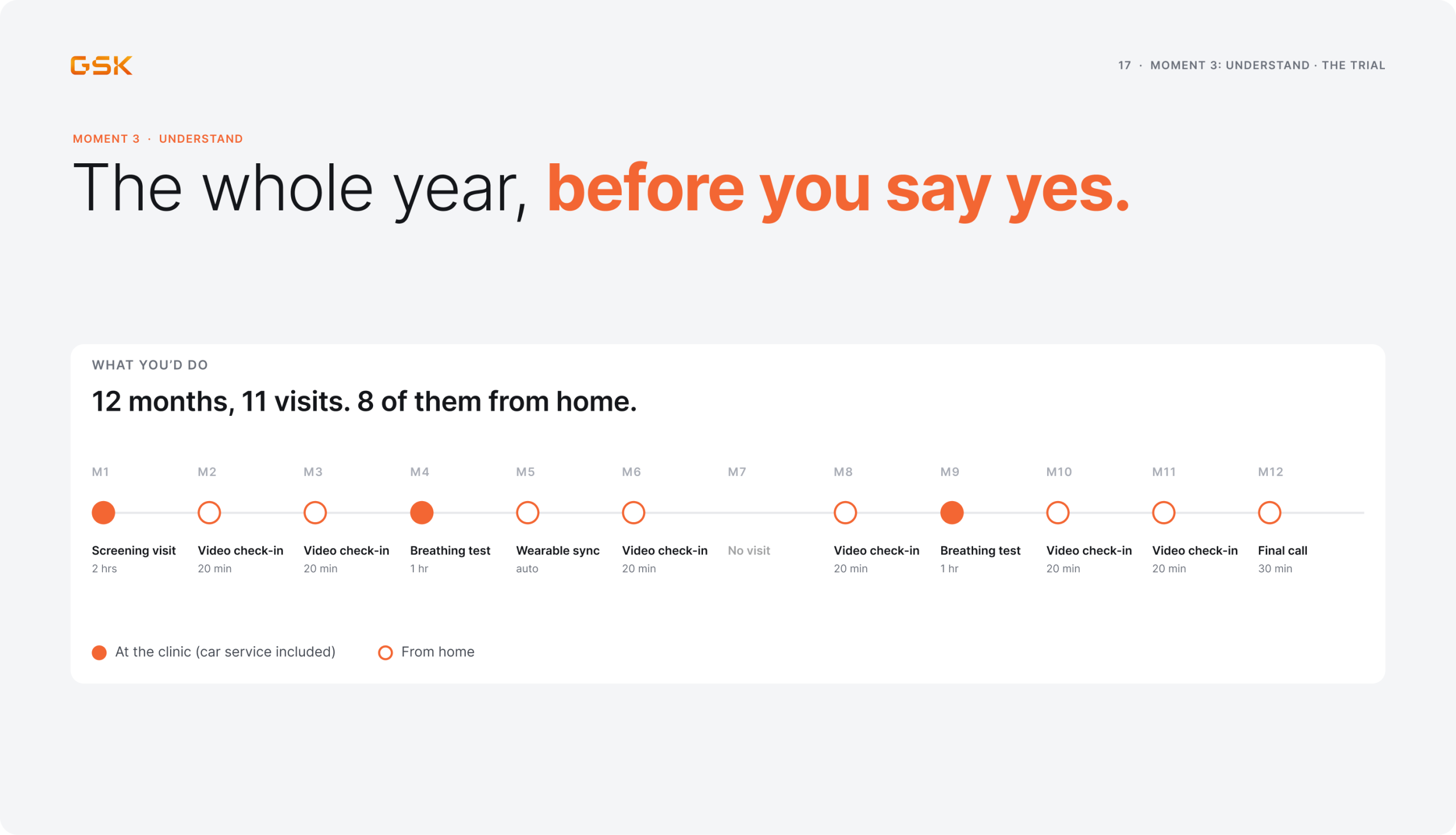
- 4. See the whole year. Before he says yes, Dennis can see all twelve months: 11 visits, 8 of them from home, with clinic days marked and a car included.
- 5. Screen and consent. He connects his health record in about a minute and gets a “you likely qualify” result the same evening. Consent comes as short video chapters with Dr. Ruiz, questions in plain words and an e-signature from home. What used to be 41 days of phone tag became one evening at home.
- 6. Take part. The companion app runs the week: video check-ins with the same nurse every time, a wearable that syncs breathing data on its own, and a car booked automatically for the three clinic days.
- 7. Rate. Thirty seconds after every visit, a single screen asks how it went: one face, a few tags and an optional comment. It goes to the study team and GSK without his name unless he chooses to share it. A “You said, we did” screen shows what changed, such as evening check-ins added after 41 participants asked for them.
- 8. Finish. When the trial ends, results arrive in the app in plain language before they reach a journal. The last question asks whether he’d join another GSK trial, which became GSK’s most honest measure of the experience.
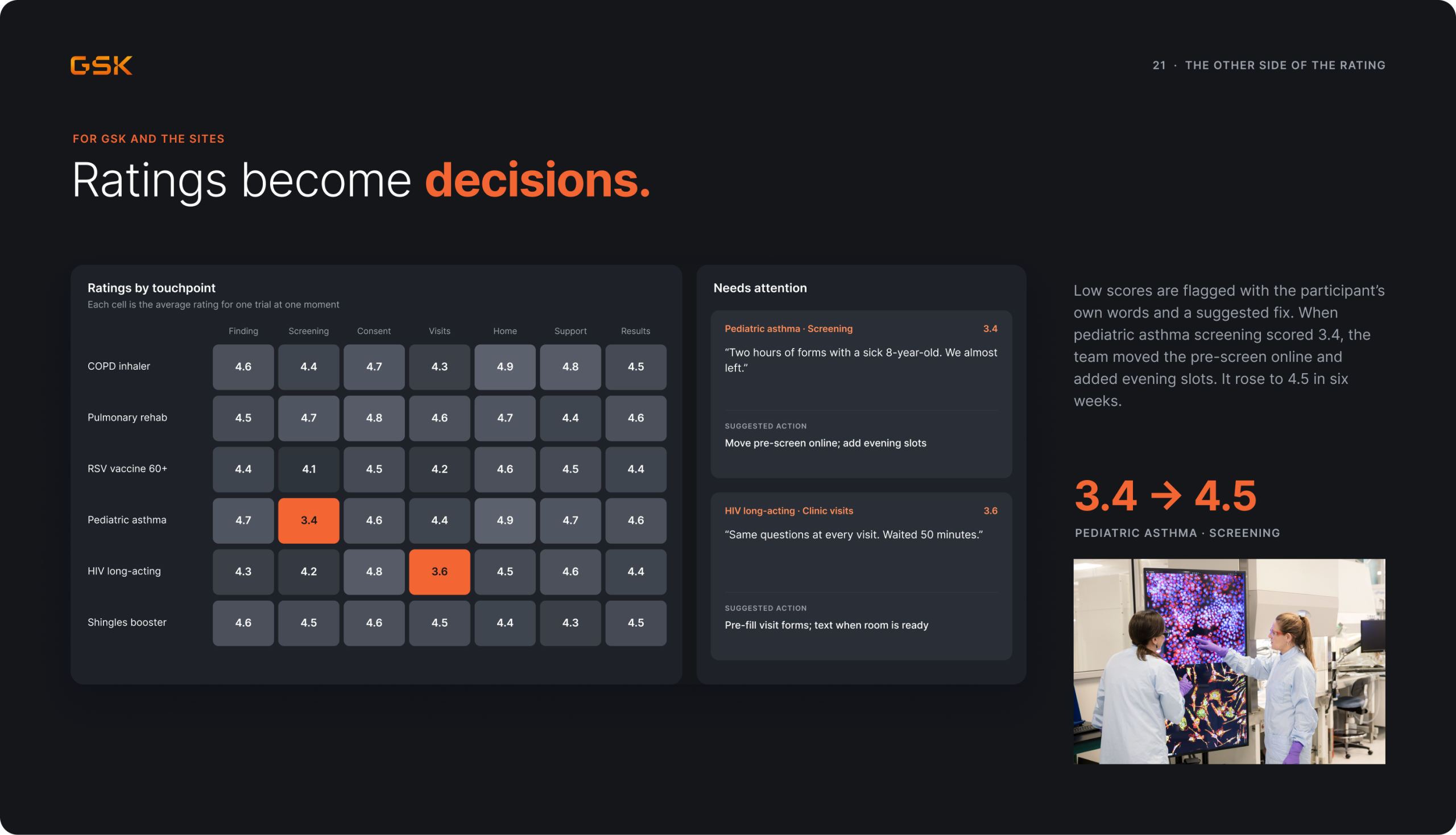
Ratings only matter if someone acts on them, so we designed the tools for GSK and the sites as carefully as the participant experience. An insights dashboard shows the average rating for every trial at every moment, flags low scores with the participant’s own words and suggests a fix. Site coordinators like Jordan get a referral queue of pre-screened people instead of a stack of cold calls.
In the pilot, pediatric asthma screening scored 3.4. Parents told us it took two hours of forms with a sick child, so the team moved the pre-screen online and added evening slots. Within six weeks the score rose to 4.5.
What We Delivered
A 12-week pilot across two COPD studies, one vaccine study and six sites, built as one system: a responsive web experience for finding and joining a trial, a companion mobile app for taking part, and the tools behind them — the matching model, the ratings dashboard and the coordinator referral queue. Every hurdle is met by a specific touchpoint, and the feedback loop runs the whole length of the trial, from the first alert to the results at the end.
Outcomes
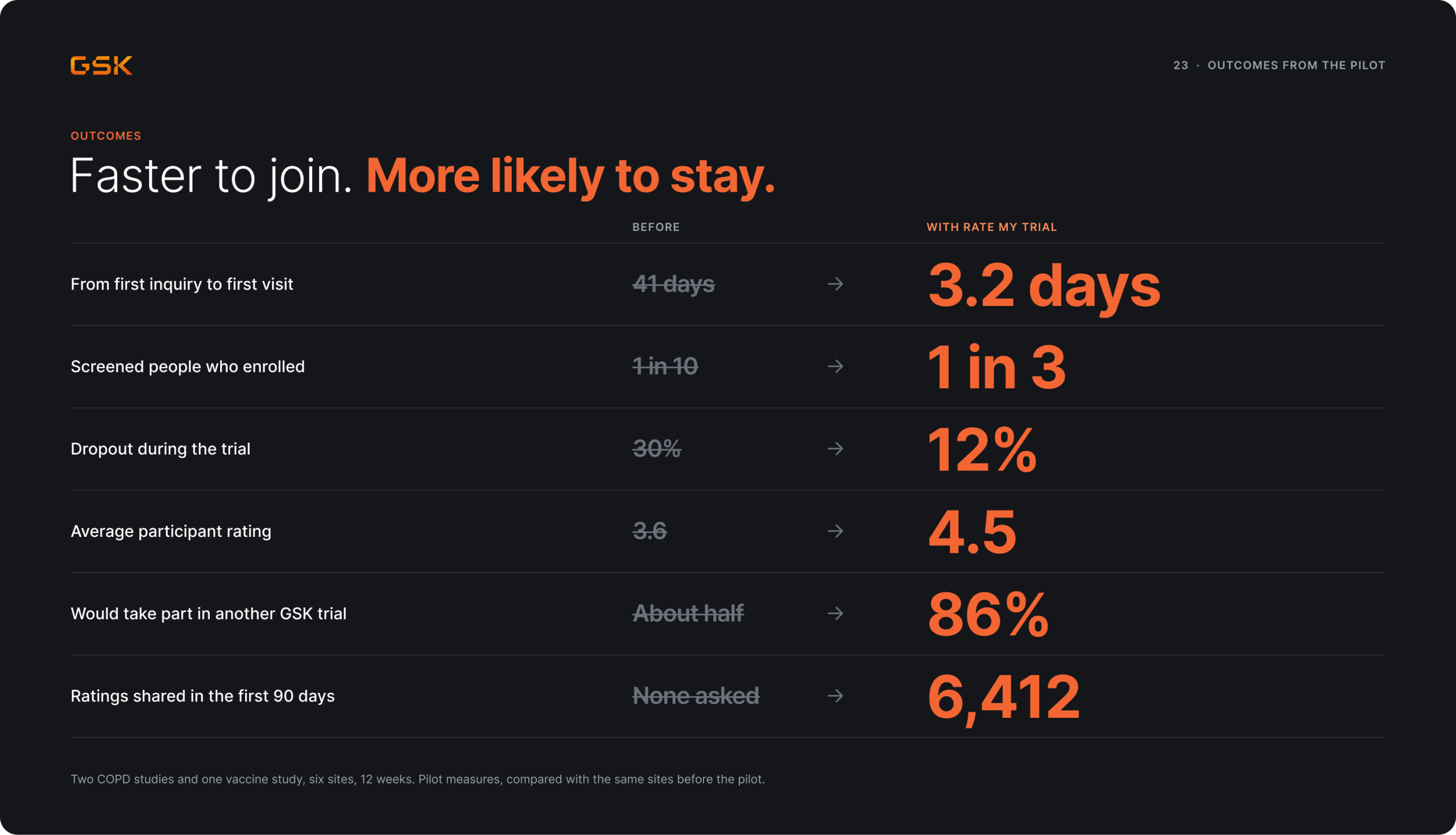
People joined faster and were more likely to stay. Measured across the pilot against the same sites before it:
- First inquiry to first visit: 41 days → 3.2 days
- Screened people who enrolled: 1 in 10 → 1 in 3
- Dropout during the trial: 30% → 12%
- Average participant rating: 3.6 → 4.5
- Would take part in another GSK trial: about half → 86%
- Ratings shared in the first 90 days: none asked → 6,412
The biggest shift was treating a clinical trial as a service rather than a protocol. Once we mapped the experience from every seat in the room, it was clear that most of the friction came from handoffs nobody owned, so the design focused on making those handoffs visible and accountable.
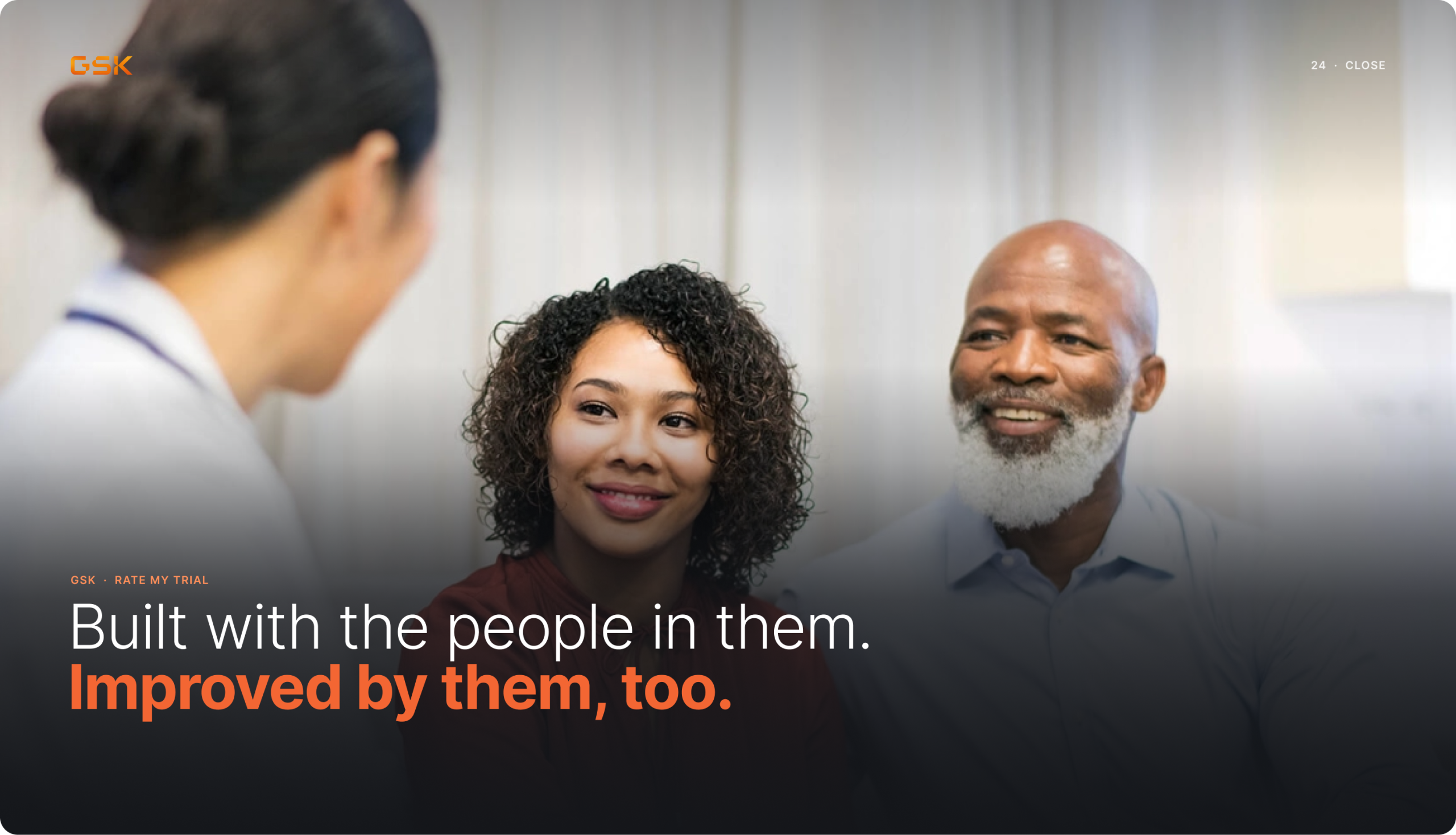
The rating loop is what kept it honest. Asking participants how each moment went, and showing them what changed because of it, turned feedback into a working tool for GSK and gave participants a reason to stay. The trial was built with the people in it, and it kept improving because of them.